About the area
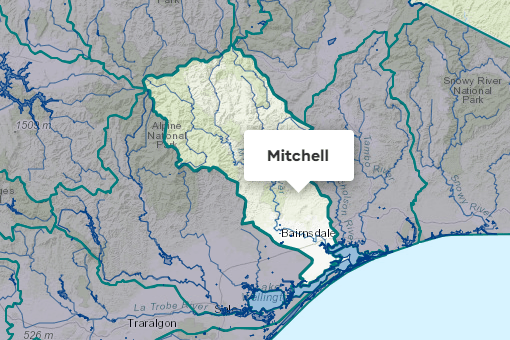
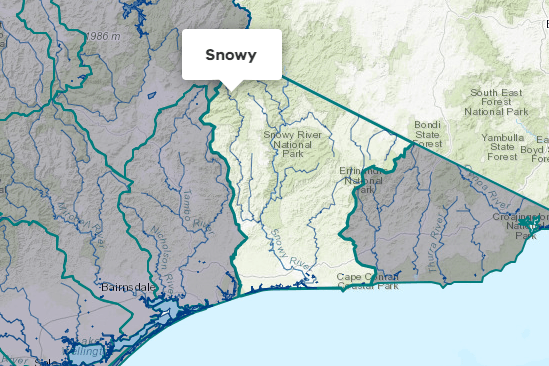
Major rivers in the Tambo basin include the Tambo, Timbarra and Nicholson, which flow into the Gippsland Lakes.
Most of the basin receives 600-900 mm rainfall annually, with some higher rainfall between 900-1200 mm in the upper basin.
Most of the basin’s area is steep, forested mountains. There is a small southern section of flat farmland and an area of farmland in the middle to upper reaches of the Tambo River valley.
More information on water management and accounting is detailed in Water explained.
2024-25 overview
Available water
Catchment inflow was lower than the previous year.
Licensed diversion restrictions
There were no restrictions on licensed diversions, the same as the previous year.
Water use
Less water was diverted for consumptive purposes than the previous year.
When compared to the previous year, in 2024-25:
- similar rainfall was received; however, catchment inflow was lower
- licensed diversion restrictions were the same with no restrictions on licensed diversions from streams
- less water was diverted from the basin for consumptive uses.
Climate
Rainfall
In 2024-25, rainfall received in the Tambo basin was similar to the previous year. Rainfall was generally average across the basin.
Figure 1 displays the rainfall received in 2024-25 compared to the long-term average (1975-2025).
Figure 1: Rainfall deciles, Tambo basin
Sourced from the Australian Bureau of Meteorology
River basin water balance
This section describes the known and estimated inflows, outflows and change of storage volumes in the basin.
More detail on catchment inflows, diversions and small catchment dams can be found in the sections below the water balance.
Diversions in the Tambo basin are minor compared to the total water resource. Swifts Creek is the only town supplied by water from within the Tambo basin, while larger towns (such as Lakes Entrance and Bruthen) are supplied by the Bairnsdale water system (sourcing water from the Mitchell basin). Overall, almost 100% of the basin inflows passed through to the Gippsland Lakes in 2024-25.
Water balance table
The table below shows the total volumes of water available and supplied from water resources in the Tambo basin in 2024-25.
Table 1: Water balance, Tambo basin
Inflows
Catchment inflow
Catchment inflow represents the volume of water flowing into the waterways of a basin. It is calculated as the total outflows and change in storage minus the known inflows.
Average inflows of 313,539 ML were received (100% of the long-term average of 314,200 ML), less than the previous year (128% of the long-term average).
Average inflow
Catchment inflow was 100% of the long-term average of 314,200 ML.
Less water received than the previous year
Catchment inflow was lower than the previous year (128% of the long-term average).
Wastewater treatment plants
Water treated at wastewater treatment plants can be used to supplement water available in the basin. Water discharged to waterways from treatment plants is included as an inflow to the water balance.
Information on treatment plants is reported in the water supply local reports for the water corporation responsible for managing the plant.
In this basin, wastewater treatment plants are managed by East Gippsland Water.
Outflows
Diversions
In 2024-25, 1,420 ML of water was diverted for consumptive uses: town, domestic and stock (water captured in small catchment dams), irrigation and commercial supply. This was less than the 1,752 ML diverted in the previous year.
Although the total volume diverted for consumptive use was lower than the previous year, the volume diverted for urban, irrigation and commercial supply was higher than the previous year, and urban diversions were similar. There was a 344 ML reduction in the estimation of use from small catchment dams.
Small catchment dams
Water harvested, used, and lost by small catchment dams (farm dams) is included in the water balance.
Table 2: Small catchment dams, Tambo basin
Entitlements and compliance
Entitlements provide the basis for how water is shared in the basin.
Entitlement volumes
Rights to water in the Tambo basin are shown in Table 3.
Entitlement volumes represent an indication of a maximum volume of water that can be taken or allocated in any one year depending on the rules of the entitlement. The volume available in a particular year is dependent on the rules for allocating water set out in the entitlement, the seasonal conditions in that year and how much water was carried over from the previous year, which can vary. The rules for allocating water under an entitlement differ between entitlements and systems. This affects the ability and likelihood of water being taken in a particular year.
Table 3: Annual entitlement volumes at 30 June, Tambo basin
Available water and take under entitlements
Total water available under entitlements represents the volume of water that was available to be taken by entitlement holders in 2024-25. The volume includes carryover from the previous year, seasonal allocations and net trade into the basin.
Water taken
There was 561 ML taken under entitlements in 2024-25, less than the previous year (637 ML).
Restrictions on licensed diversions from streams
There were no restrictions on licensed diversions from streams in 2024-25, the same as during the previous year.
Available water and take table
This table shows the volume of available water and the volume taken under entitlements in 2024-25.
More information on available water and take has been detailed in How we account for surface
In 2024-25, less water was taken under entitlements than the previous year.
Table 4: Available water and take under entitlements, Tambo basin
Compliance
Compliance against water entitlements is reported for this basin in 3 areas:
- entitlement issued: that the volume of entitlements issued in a basin does not exceed formal caps, and has not increased without appropriate approvals
- water taken: that the volume of water taken during the year does not exceed the volume considered to be available for consumptive and/or in-stream use during that year
- bulk entitlement provisions: that holders of entitlements do not breach any provisions that are documented in their bulk entitlement orders.
Key points on compliance against entitlements in 2024-25
Total entitlement volume
There was no net increase in the total entitlement volume from the previous year.
Total volume diverted
The total volume diverted under entitlements (561 ML) was within the volume available for the year (7,034 ML).
Individual bulk entitlements
No individual bulk entitlement holder took more than the annual volume made available to them.
Exceptions to compliance
Individual bulk entitlement holders complied with all provisions in their entitlements.
Water for the environment
Environmental watering sites
There are no environmental entitlements in the Tambo basin, so no active environmental watering occurs.
However, important sites and environmental values in the Tambo basin that depend on water for the environment include:
- the Gippsland Lakes, which are listed as internationally significant wetlands under the Ramsar Convention and which partially rely on freshwater inputs from the Tambo basin to function ecologically
- populations of Australian grayling and black bream
- the Tambo River, which has an extensive estuary extending from The Cliffs (upstream of Swan Reach) to the Gippsland Lakes at Lake King; significant wetlands along the estuary reach of the river include the East Swamps (south of Sardine Flat Road), Lake King Wetlands and Russells Swamp
- the Nicholson River, which has an extensive estuary reach that extends from the Great Alpine Road bridge at Sarsfield to where the river enters the Gippsland Lakes at Jones Bay; there are several important wetlands on both sides of the river, the largest being Bosses Swamp and Nebbor Swamp.
Environmental water reserve
In 2024-25, water for the environment in the Tambo basin comprised:
- water set aside for the environment through the operation of passing flow conditions:
- consumptive bulk entitlements held by East Gippsland Water
- on licensed diversions
- all other water in the basin not allocated for consumptive uses: this water also provides social, recreational and cultural benefits.
Management responsibilities
Management of water in the Tambo basin is undertaken by various parties.
| Authority | Management responsibilities |
|---|---|
| East Gippsland Catchment Management Authority |
|
| East Gippsland Water |
|
| Southern Rural Water |
|
| Water supply system | 2023-24 (ML) | 2024-25 (ML) |
|---|---|---|
| Swifts Creek | 22 | 19 |