About the area
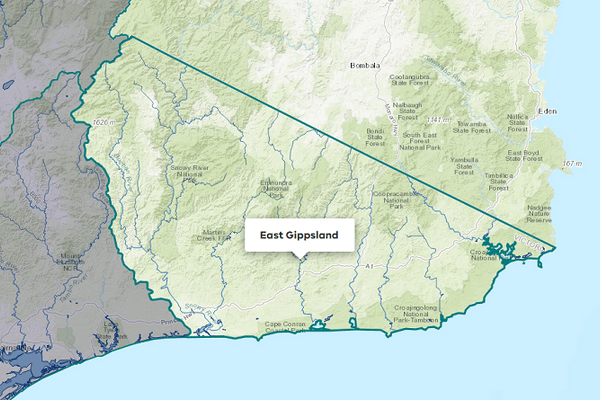
The Central Gippsland groundwater catchment is in Victoria’s east, and it contains the Gippsland Lakes.
The Central Gippsland groundwater catchment contains the Rosedale groundwater management area (GMA), Wa De Lock GMA, Denison GMA, Sale water supply protection area (WSPA), Stratford GMA, Moe GMA, Yarram WSPA, and Wy Yung GMA. The geographical area within the catchment containing licensed entitlement that is not covered by these is reported as outside management units.
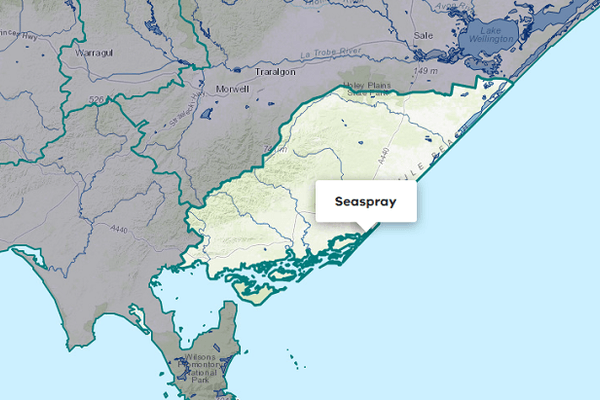
The Stratford GMA and Yarram WSPA extend into the Seaspray groundwater catchment. The Moe GMA straddles this catchment and the Moe groundwater catchment.
Groundwater resources within the catchment supply licensed entitlements, domestic and stock use, urban use to Sale, Boisdale, Briagolong, and Lindenow, and power generation in the Latrobe Valley.
More information on water management and accounting is detailed in Water explained.
2024-25 overview
Urban supply
Groundwater supplied to 2 towns in the catchment.
Water use
Water used for consumptive purposes was similar to the previous year.
Climate
Rainfall
Less rainfall was received in the Central Gippsland groundwater catchment in 2024-25 than the previous year, ranging from above the long-term average to the lowest recorded in the reference period (1975 to 2025) across the catchment. Rainfall was:
- above average in central regions of the catchment
- average throughout most of the catchment north of Sale
- below average across mostly a south-western band spanning Rawson to Rosedale
- very much below average over parts of the catchment’s south-west
- the lowest recorded in the reference period (1975 to 2025) in the catchment’s far south-west, encompassing Thorpdale and Yinnar.
Figure 1 displays the rainfall received in 2024-25 compared to the long-term average (1975-2025).
Figure 1: Rainfall deciles, Central Gippsland groundwater catchment
Sourced from the Australian Bureau of Meteorology
Groundwater level trends
In the Accounts, groundwater level trends for groundwater management units (GMUs) have been determined by monitoring data from key bores in the State Observation Bore Network. Trend determinations are made quarterly by comparing each reading to a previous reading in the same season 5 years prior; for example, a summer record is compared to the summer record from 5 years earlier to account for seasonality. These trends are shown in Table 1 below.
Groundwater level trends reporting in the Accounts does not necessarily represent the status of the resource for management purposes. Groundwater resources are actively managed by rural water corporations. For more detail on management responses, go to Groundwater on the Southern Rural Water
In 2024-25, groundwater level trends toward the end of the year were rising in 2 GMUs, stable in 3 GMUs, and declining in 2 GMUs.
There are insufficient state observation bores in the Denison GMA to adequately define the groundwater resource or changes to the resource over time.
Table 1: Groundwater level trends, Central Gippsland groundwater catchment
Response to water availability
Groundwater restrictions
There were no restrictions on licensed groundwater use in 2024-25, the same as previous year.
Entitlements and use
Groundwater licence and use volumes in the Central Gippsland groundwater catchment are shown below. Domestic and stock use does not require a licence, so in the Groundwater availability and take table (Table 3), these rows only report water taken.
The licensed volume used under entitlements must not exceed the volume made available to individual licensed entitlement holders. We report on compliance in the GMU local reports and in the Statewide groundwater summary.
Water used
Use in the Central Gippsland groundwater catchment was 62,086 ML, similar to the 56,520 ML used in the previous year.
Entitlement volumes
Rights to water in the Central Gippsland groundwater catchment are shown below.
Table 2: Groundwater entitlements at 30 June, Central Gippsland groundwater catchment
Available water and take
The table below shows the total water available and taken under entitlements, and estimated domestic and stock use in 2024-25. Total water available under entitlements is calculated as the sum of: opening carryover from the prior year (where available), allocation issued during the reporting year, and the net trade in or out of water, across all entitlements. The level of allocation issued is reduced if there are any restrictions in place.
Estimated domestic and stock use is calculated based on an assumed usage per registered bore per year. In this catchment, the assumed usage is 1.5 ML per bore per year.
More information on groundwater use and availability has been detailed in How we account for
In 2024-25, 62,086 ML of water was extracted for consumptive purposes, which was similar to the 56,520 ML extracted in the previous year. Of this volume, 25,890 ML was for power generation use, 32,255 ML was for non-urban (irrigation) use, 2,046 ML was for urban use and 1,895 ML was estimated to be for domestic and stock use.
Table 3: Groundwater availability and take, Central Gippsland groundwater catchment
Management responsibilities
Management of water in the Central Gippsland groundwater catchment is undertaken by Southern Rural Water.
| Authority | Management responsibilities |
|---|---|
| Southern Rural Water |
|