About water for the environment
Water for the environment has been a part of policy in Victoria since 1987 when an annual allocation of 27,600 ML of water was committed to the Victorian Murray wetlands through the Victorian Murray Wetlands Environmental Water Allocation. Water for the environment is water managed to maintain the health of rivers and wetlands.
Water is specifically set aside for the environment in Victoria’s water management framework in 3 ways:
- water entitlements (managed environmental water)
- obligations on consumptive entitlements (passing flows and rules in management plans)
- above cap water (water available above the total volume that can be allocated under entitlements for consumptive use).
This report presents information on environmental water entitlements and managed environmental water delivered during 2024-25. Other sections of the VWA website show water flows that benefit the environment, including:
- passing flows on bulk entitlements: this is water that is released from storages (such as reservoirs) to operate river and water distribution systems. Passing flows help maintain environmental values and other community benefits. On some bulk and environmental entitlements, passing flows can be flexibly managed (temporarily reduced, and then released later) for the Victorian Environmental Water Holder (VEWH). We report on compliance with bulk and environmental entitlement provisions, which include passing flow requirements, in the compliance section of each river basin local report
- rules in management plans: when water is scarce, rosters, restrictions and bans are placed on licensed diversions from streams to ensure water is available for all users. These restrictions/bans are reported in Statewide surface water and the river basin local reports
- water leaving the basin: water leaving the basin is water that flows out of basins at their downstream ends. This includes all water flowing through the system, excluding diversions and losses. In terms of water for the environment, it includes managed environmental water delivered in-stream, obligations on consumptive entitlements (such as passing flows) and above cap water. We report on water leaving the basin in Statewide surface water.
Above cap water cannot be directly measured and is not reported in these Accounts.
2024-25 overview
78 Wetlands
Water was delivered to 78 wetlands.
90 River reaches
Water was delivered to 90 river reaches.
88% watering actions achieved
189 of 215 of required watering actions were either fully or partially achieved.
The VEWH is an independent statutory body responsible for managing Victoria's environmental water. The VEWH is part of a statewide partnership program that plans, manages, delivers and evaluates environmental water use.
As of 2024-25, the VEWH has managed water for the environment in Victoria for 13 years. Each year, the number of watering actions that are delivered depends on seasonal and operational conditions experienced throughout the year.
In 2024-25:
- The VEWH’s Seasonal Watering Plan 2024-25 identified 266 potential watering actions across Victoria; 215 of these actions were required in 2024-25
- The VEWH coordinated delivery of environmental water to 90 priority river reaches and 78 wetlands, a total of 168 sites across Victoria (similar to the 161 sites in the previous year)
- 189 of 215 (88%) of required watering actions were fully or partially achieved:
- 161 included a contribution from managed environmental water
- 28 were achieved through passing flows, natural flows, unregulated flows and/or the delivery of consumptive water.
For more information on how VEWH has managed environmental water, visit the VEWH’s to view and download publications including annual reports and seasonal watering plans.
Managed environmental water
Managed environmental water is held in 16 Victorian river basins. Most of the water entitlements held for the environment are specified as a legal right to a share of the water available in storages that can be released to meet certain environmental needs. Carryover, trade and seasonal allocation provisions on these entitlements typically operate the same way as for water entitlements held for consumptive purposes.
Environmental entitlements are held in Victorian river basins for environmental purposes by the VEWH and the Commonwealth Environmental Water Holder (CEWH). Entitlements held by the VEWH include those it holds in trust for the Murray-Darling Basin Authority (MDBA) for The Living Murray program. These authorities and others work together to ensure that the delivery of environmental water is well coordinated.
This section describes the volumes available under environmental entitlements, and the total volumes delivered. Total available includes:
- Carryover: water that has been carried over from the previous year under environmental entitlements
- Seasonal allocations / share of inflows: water allocated to entitlements during the year
- Return flows: the volume of water available to be re-used for the environment, made available from prior delivery at upstream locations
- Net trade (excluding volume transferred to South Australia): this is calculated as the volume traded to environmental water holders from private or water corporation owners, minus the volume traded from the environmental water holders to these other parties
- Less carryover/allocation written-off: this subtracts deductions to carryover or allocation to account for a spill, evaporation or change in storage event
- Less borrowed BMF EWA at 30 June: this subtracts the volume of Barmah-Millewa Forest Environmental Water Allocation (BMF EWA) water borrowed to support Victorian Murray high-reliability water shares.
Total volume delivered in Table 1 reports the volumes delivered by environmental water holders to off-stream wetlands, within the river channels plus the volume transferred to South Australia for the environment
In 2024-25, the total volume of VEWH, CEWH and MDBA managed environmental water available was 2,314,846 ML, similar to the previous year. Of this, 945,836 ML was delivered during the year to priority river reaches and wetlands in Victoria, with a further 544,900 ML transferred to South Australia for delivery in the South Australian Murray system (Table 1).
Table 1 provides a summary of water availability and deliveries of managed environmental water for 2024-25. It includes the volume delivered in Victoria and through to South Australia. Data for Accounts from 2015-16 to is available to download; however, this table in those Accounts did not explicitly report on net trade or volume transferred for delivery in South Australia.
Table 1: Summary of managed water for the environment
Return flows In some systems, water for the environment delivered through upstream sites can be made available to be used again downstream without impacting other entitlement holders. This helps to ensure it is used efficiently and effectively to achieve optimal environmental benefits. Access to return flows for the environment are enabled through rules in the VEWH’s bulk and environmental entitlements. In 2024-25, a total of 558,323 ML was re-credited to the VEWH’s accounts for return flows delivered through upstream sites to the Murray River, similar to the 603,425 ML during the previous year. Additionally, 107,408 ML delivered in the Goulburn River between Lake Eildon and Goulburn Weir was re-credited to the VEWH in Waranga Basin (49,370 ML in 2023-24) and 611 ML delivered from Lake Merrimu in the Werribee system was re-credited in Melton Reservoir (0 ML in 2023-24). |
Trade
There are 2 general types of trade undertaken by environmental water holders – administrative transfers and commercial allocation trade.
Examples of administrative transfers undertaken in 2024-25 include:
- transfers within Victoria between the VEWH, CEWH and the Living Murray allocation accounts to facilitate delivery and optimise carryover
- 544,900 ML transferred to South Australia for delivery in the South Australian Murray system
- 90,596 ML transferred to the Snowy Mountains Scheme inter-valley transfer account
- the Taungurung Land and Water Council Aboriginal Corporation transferring 39 ML of water allocation to the VEWH for delivery in the Ovens system (King River) for environmental and cultural outcomes
- the VEWH receiving allocation donated from private landholders in the Ovens (King River) (56 ML) and Murray (17 ML) systems.
In 2024-25, commercial allocation trades undertaken by the VEWH and the Commonwealth included:
- 35,978 ML sold to non-environmental users in the Murray and Goulburn systems
- 5,671 ML of carryover parking from 2023-24 returned to private owners
- 2,500 ML of privately owned allocation transferred to VEWH accounts for carryover which will be returned to owners in 2025-26 subject to contractual arrangements.
Entitlements, availability and use
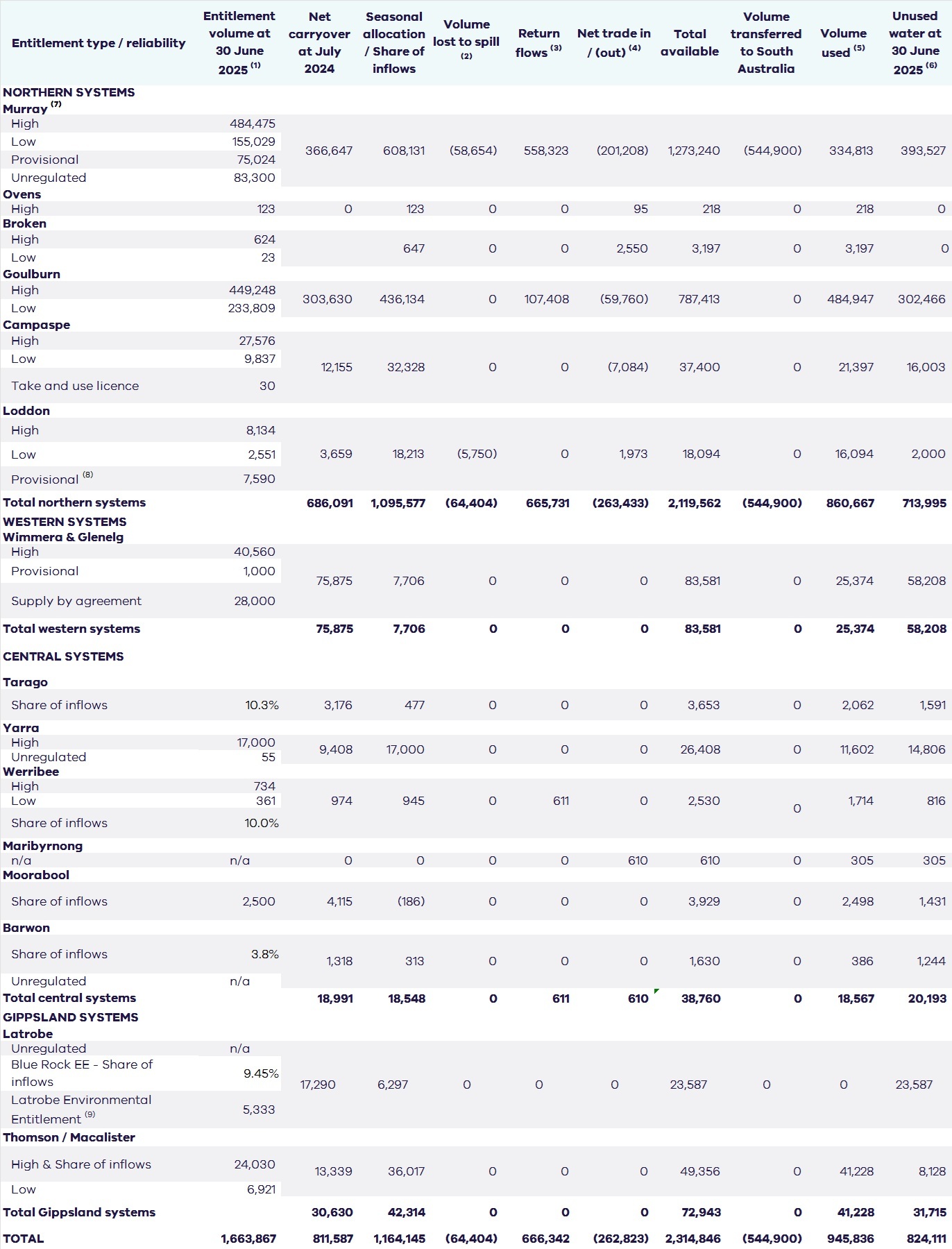
Table 2 summarises, per river basin, the volume of environmental entitlements as at 30 June 2025 and shows how much water was made available, traded and delivered during the water year.
Entitlements can have different reliabilities of supply. Table 3 below shows the total entitlement volume for each reliability. The different reliabilities are:
- high (reliability): secure entitlements to a defined share of water; full allocations are expected in most years
- low (reliability): secure entitlements to a defined share of water; full allocations are expected only in some years
- provisional: entitlements that provide access to water based on specific conditions in the related bulk or environmental entitlement
- unregulated: entitlements linked to flow conditions in the river rather than volumes of water in a storage; unregulated entitlements permit diversion of in-river flows above a certain height or rate or flows that are in excess of what can be captured in storage
- share of inflows: shares of inflows into water storages that can be released to meet particular environmental needs.
Under some entitlements, unused water from one year can be carried over into the next to support watering actions in subsequent years. Carryover provides flexibility and enables water for the environment to be delivered when it is of the greatest value to the environment.
In 2024-25, 2,314,846 ML was made available under environmental entitlements during the year (before trade), compared to 2,383,886 ML in 2023-24. Of the volume available, 945,836 ML was used for environmental benefits within Victoria, compared to 933,030 ML in 2023-24 (Table 2).
Table 2: Environmental water availability and use (ML)
Snowy Water Initiative
The Snowy Water Initiative was formally established in 2002 to increase flows in the Snowy River. It was established in response to the impact the Snowy Mountains Scheme (Snowy Scheme) was having on the river’s health. As part of this initiative, the Victorian, New South Wales and Commonwealth governments committed to recovering water from the Murray-Darling Basin to increase flows in the Snowy and Murray rivers.
The Victorian Government met its commitment to recover water from the Murray, Goulburn and Loddon systems by 2012. This resulted in the creation of water entitlements, which are now held by the VEWH. Each year, the water allocated to these entitlements as of 31 January is transferred to the Snowy Scheme, where it is made available for release into the Snowy and Murray rivers for environmental benefit.
These transfers reduce the amount of water Snowy Hydro Limited is required to release from the Snowy Scheme to the Murray in the following year. In accordance with intergovernmental agreements, 2-thirds of the withheld water is released to the Snowy River for environmental benefit, and the remaining third (up to 70,000 ML) provides flows for the environment in the Murray River.
In January 2025:
- A total of 238,360 ML was transferred to the Snowy Scheme in 2024-25 for release in future years (including New South Wales’ contributions) (Table 3). Of this volume:
- 168,360 ML was assigned for release to the Snowy River (Snowy River Increased Flows)
- 70,000 ML was assigned for release to the Murray River (River Murray Increased Flows). This is shared equally between New South Wales and Victoria.
Table 3: Water allocation recovered under the Snowy Water Initiative for future releases
In 2024-25, water allocation recovered under the Snowy Water Initiative was released for environmental benefit in both the Snowy and Murray rivers:
- 206,300 ML of Snowy River Increased Flows was released to the Snowy River from Jindabyne Dam, in addition to the 8,500 ML base passing flow and 500 ML riparian flow released from Mowamba Weir.
- 20,442 ML of River Murray Increased Flows was also released from the Snowy Scheme to the Victorian Murray System.
Managed passing flows
In addition to water delivered under entitlements, in some systems VEWH can use entitlement provisions to flexibly manage passing flows. This involves requesting the Storage Manager to hold back passing flows which are held in a passing flow account for release later to deliver environmental benefits.
These provisions can exist in entitlements held by the VEWH, or by water corporations.
Table 4 below shows the volumes of passing flows that were flexibly managed in 2024-25.