On this page:
About groundwater
Groundwater is found in the spaces and fractures in rock and sediment beneath the ground’s surface, known as aquifers. Groundwater held in an aquifer can be pumped to the surface for use.
This summary reports on statewide groundwater use, entitlements and compliance, and trade for 2024-25.
We report on groundwater availability and use across 2 different reporting units: groundwater catchments and groundwater management units (GMUs). These can be found in the groundwater local reports.
Victoria has 20 groundwater catchments, 8 in the north and 12 in the south.
Within groundwater catchments, GMUs are typically smaller regions that are either water supply protection areas (WSPAs) or groundwater management areas (GMAs). There are 55 GMUs: 45 are GMAs and 10 are WSPAs.
Groundwater resources that are licensed and used outside a WSPA or GMA are reported as outside management units.
More information:
- Groundwater resources are explained in Water resources.
- Water management is detailed in How is water managed?
- Groundwater accounting is detailed in How do we account for water?
2024-25 overview
Restrictions on use
There were 3 (out of 55) GMUs subject to restrictions on groundwater use, the same as the previous year.
GMU changes
There were 3 gazetted PCV changes to GMUs.
Water use
More groundwater was taken for consumptive use than the previous year.
In 2024-25:
- there were a similar number of GMUs displaying stable groundwater level trends, more declining trends and fewer rising trends compared to the previous year
- there were 3 GMUs that were subject to restrictions on groundwater use, the same as the previous year
- there were 3 gazetted changes made to GMUs
- a similar volume of groundwater was available to be taken under entitlements as the previous year
- there was 22% more groundwater taken for consumptive purposes than the previous year (365,535 ML, compared to 298,927 ML in 2023-24)
- there were more temporary trades of groundwater take and use licences, but fewer permanent trades, and a similar number of trades as part of land transfers compared to the previous year.
Groundwater level trends
Groundwater systems are dynamic and adjust continually to short-term and long-term changes in climate, groundwater withdrawal, and land use. Groundwater trends are one type of measure that can give an indication of the condition of the groundwater resource, somewhat like storage levels for surface water. Trends in groundwater levels reflect differences between the amount of water flowing into (recharge) and out of (discharge or extraction) an aquifer.
For more information on why we report on groundwater levels, see Keeping track of Victoria’s
In the Accounts, groundwater level trends for GMUs have been determined based on monitoring data from key bores in the State Observation Bore Network. Trend determinations are made quarterly by comparing each reading to a previous reading in the same season 5 years prior. That is, a summer record is compared to the summer record from 5 years earlier to account for seasonality.
Groundwater level trends reporting in the Accounts does not necessarily represent the status of the resource for management purposes. Groundwater resources are actively managed by rural water corporations. For more detail on management responses, visit Groundwater on the Goulburn-Murray , Grampians Wimmera Mallee and Southern Rural websites.
2024-25 groundwater level trends
Table 1 shows groundwater level trends for each quarter in the past two years. Figure 1 shows a graphical representation of the trends for the last quarter of the year, April to June 2025.
The number of GMUs that were categorised as stable was similar to the previous year, whereas there were more as declining and fewer as rising:
- Of 10 WSPAs, 3 were categorised as stable, 3 as rising, and 4 as declining, compared to 2 as stable, 7 as rising, and 1 as declining in the previous year.
- Of 41 GMAs, 16 were categorised as stable, 12 as rising, 12 as declining, and one as insufficient data, compared to 15 as stable, 16 as rising, 4 as declining, and 5 as insufficient data in the previous year.
Table 1: Groundwater level trends
Response to water availability
The amount of water available for consumptive and environmental uses will vary from year to year. The water entitlement and planning includes mechanisms that come into play when water is scarce. The aim is to conserve and share water between users in response to seasonal variability and water shortages. These mechanisms include restrictions to licence volumes in groundwater systems.
Groundwater licences are all-year licences. Management plans for some GMUs may include water levels that will trigger restrictions to reduce the volume of water that users can take under their licence.
Groundwater restrictions
In 2024-25, entitlement holders in 3 GMUs were subject to restrictions on groundwater use, the same number as during the previous year. Restrictions are expressed as a percentage (below 100%) of the licence volume that the licence holder is allocated for the year. The restrictions were as follows:
- Campaspe groundwater catchment – Barnadown zone in the Lower Campaspe Valley WSPA, 75%.
- West Port Phillip Bay groundwater catchment - Deutgam WSPA, 50%.
- West Wimmera groundwater catchment - Neuarpur subzone 1 in the West Wimmera GMA, 80%.
Water use
In Victoria, groundwater can be taken from aquifers under entitlements issued and authorised under the Water Act 1989. Both water corporations and individuals/businesses can hold groundwater entitlements, which are generally issued as take and use licences. In addition to this, there is one groundwater bulk entitlement issued to Barwon Water for urban supply to the Greater Geelong area.
The Act also enables individuals to take water for domestic and stock use from groundwater without a take and use licence.
Domestic and stock use is estimated based on the number of domestic and stock bores in each GMU and outside management units.
More information on groundwater accounting and use is detailed in How we account for groundwater.
Total use and use by type
The total groundwater use across the state - including domestic and stock use - was 365,536 ML, which was more than the 298,927 ML used in 2023-24 (Figure 2 and Table 2).
Use in groundwater management units (GMAs and WSPAs):
- There was 833,530 ML of licensed entitlement and 311,569 ML of metered use (compared to 831,890 ML of licensed entitlement and 245,935 ML of metered use in 2023-24).
- There was 22,289 ML of estimated domestic and stock use (compared to 22,336 ML in 2023-24).
Use outside of management units:
- There was 117,866 ML of licensed entitlement and 24,025 ML of metered use (compared to 117,244 ML of licensed entitlement and 23,149 ML of metered use in 2023-24).
- There was 7,652 ML of estimated domestic and stock use (compared to 7,507 ML in 2023-24).
Use by type
In 2024-25, groundwater was used for:
- irrigation/commercial purposes*: 299,102 ML (82% of total use)
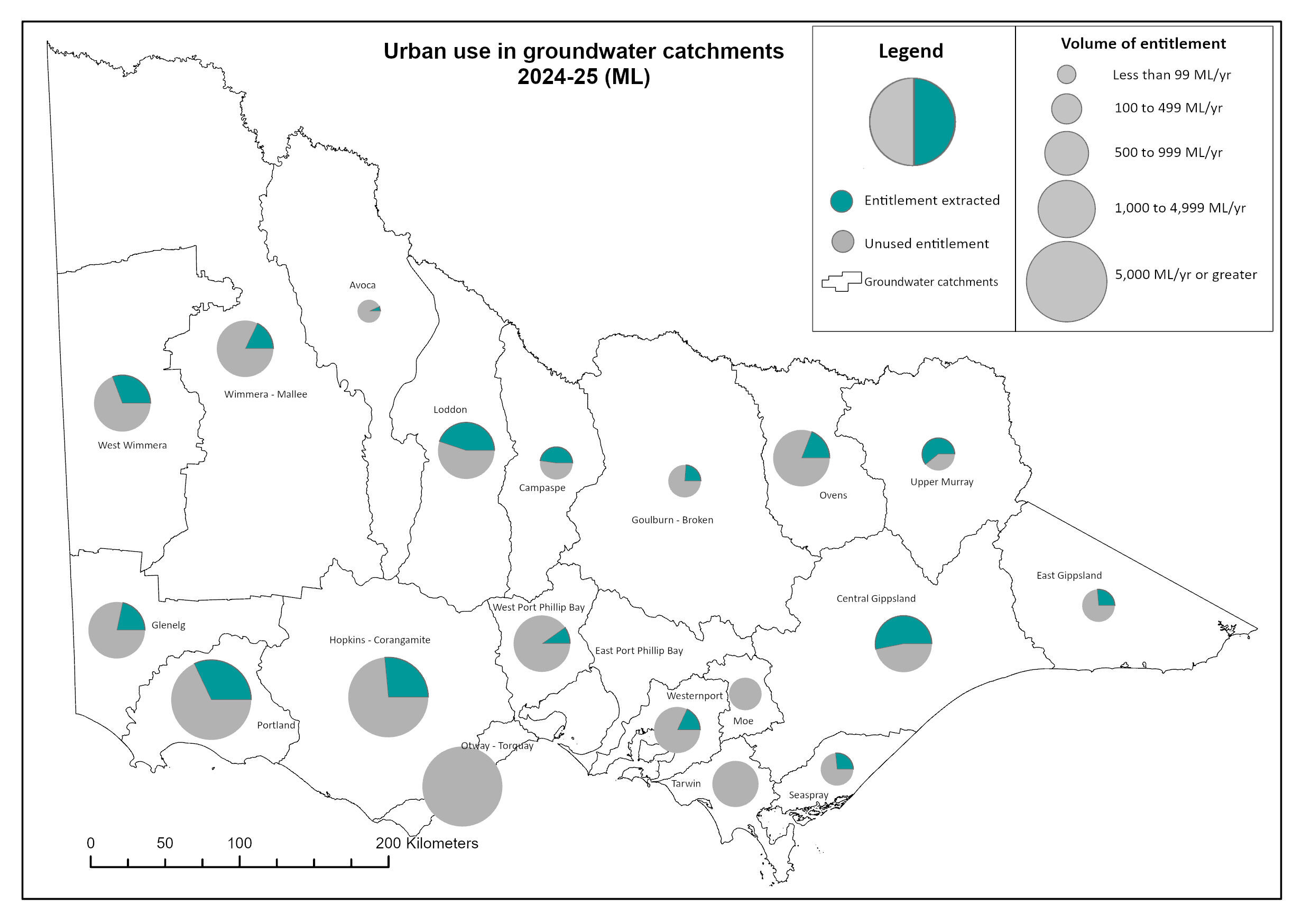
- urban purposes: 10,603 ML (3% of total use)
- power generation: 25,890 ML (7% of total use)
- domestic and stock purposes: 29,941 ML (8% of total use). This estimate is based on a count of 17,867 domestic and stock bores in Victoria that were less than 30 years old (considered to be currently active) in 2023-24 (compared to 17,815 in 2023-24).
* Note: Data for the irrigation and commercial categories are reported together as they cannot be separated for groundwater use.
Figure 2 and Table 2 show the volumes of groundwater use by type.
Table 2: Groundwater diverted for different consumptive uses
Entitlements and compliance
Entitlements
Entitlements provide the basis for how water is shared. The total volume of entitlements changes each year as new entitlements are issued, or existing entitlements are modified. All GMUs have a permissible consumptive volume (PCV), which limits the volume of groundwater that can be allocated. In areas that have reached the PCV and allocated all available groundwater within the limit, no new entitlements are created unless water savings are made, and so there is no net increase in entitlement volume.
More information on groundwater management arrangements is detailed in How we account for groundwater.
Groundwater entitlements and use from each GMA and WSPA are detailed in Table 3.
In 2024-25, the total licensed entitlement volume for Victoria was 951,396 ML. This was very close to the licensed volume in 2023-24 (949,134 ML).
Available water and take
Total groundwater available under entitlements is calculated as the sum of: opening carryover from the prior year (where available), allocation issued during the reporting year, and the net trade in or out of water, across all entitlements. The level of allocation issued is reduced if there are any restrictions in place.
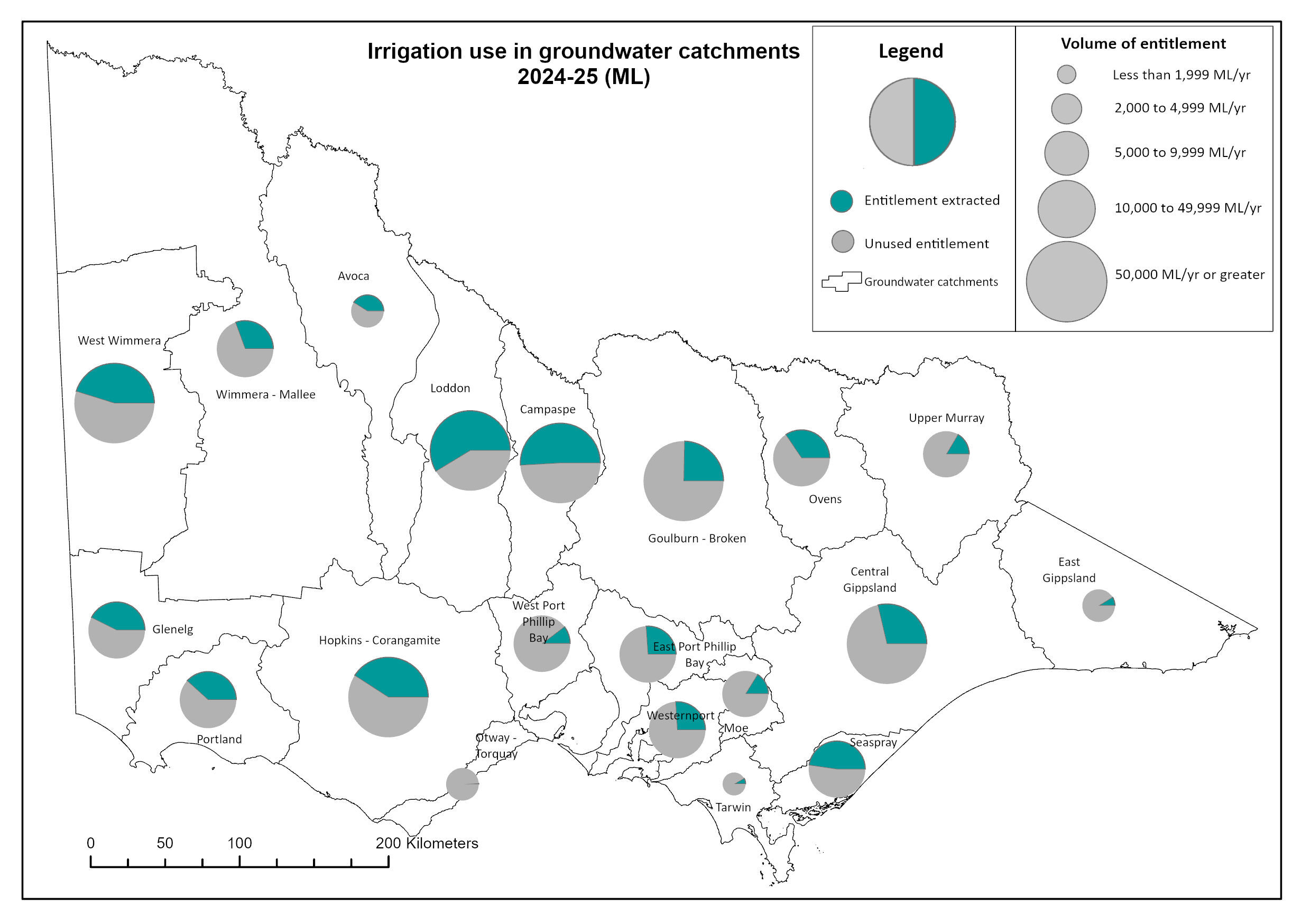
In 2024-25 (Table 3 and Figure 4):
- 1,014,728 ML was available to take under entitlements (compared to 996,860 ML in 2023-24)
- 335,594 ML was taken under entitlements (compared to 269,084 ML in 2023-24).
Groundwater entitlement and groundwater taken for consumptive use
In Table 3:
- permissible consumptive volume (PCV) sets the total volume of groundwater that may be licensed and taken in a GMU. PCVs are declared by the Minister for Water through an order published in the Victoria Government Gazette
- licensed entitlement volume shows the volume of entitlements for each GMU as at the end of the water year
- the water available and taken under licenses section shows the total volume of groundwater available for extraction during the water year, and the volume of licensed use in GMUs and outside management units. Total water available under entitlements is the sum of: opening carryover, allocation issued and the net trade in of water
- the compliance sectionshows how much groundwater was taken as a percentage of the PCV and whether there was any additional license volume available within the PCV limit
- estimated domestic and stock use is based on the number of domestic and stock bores in each GMU and outside management units within each water corporation area.
The accounting method is explained further in How we account for groundwater.
Figure 5 shows the licensed entitlement, licensed use, and domestic and stock use for the last 7 years.
Table 3: Groundwater entitlements and groundwater taken for consumptive use
Compliance
Compliance against groundwater entitlements is reported in these Accounts in 3 areas:
- entitlement issued: that the volume of entitlements (not applicable for domestic and stock water use) issued in a GMU (either a WSPA or a GMA) does not exceed the PCV or has not increased without appropriate approvals
- water taken: that the volume of water taken under entitlements during the year does not exceed the total water available to licence holders in that year
- bulk entitlement provisions: that holders of entitlements do not breach any provisions that are documented in their bulk entitlement orders.
PCV compliance is not assessed in the following 7 GMUs:
- Rosedale and Stratford GMAs: current compliance assessment criteria are not applicable. Coal mine licences are physically located in the area, however due to a lack of clarity about the inter-aquifer behaviour of resources, it is not possible to assign or assess licence volume and extraction against the Rosedale or Stratford GMA PCV.
- Shepparton Irrigation Region GMA: there is no PCV as there is no limit on the total volume of shallow groundwater entitlement available.
- South West Limestone GMA: there is no PCV that applies for the whole of the South West Limestone GMA. The South West Limestone GMA includes the areas of the former Nullawarre and Yangery WSPAs, and the Hawkesdale and Heywood GMAs, as well as the areas outside the former GMUs but included within the South West Limestone GMA boundary. The PCVs for the 4 GMUs have not been revoked and still apply. The PCV volumes are: 22,741 ML for Nullawarre, 14,352 ML for Yangery, 16,161 ML for Hawkesdale and 8,500 ML for Heywood. Currently, compliance against these previous GMUs cannot be confidently assessed due to data limitations, and consequently there is a risk that PCVs may be exceeded. Improvements are underway to address this limitation in future Accounts.
- Upper Ovens River WSPA: a PCV is not required because the management plan prevents additional entitlements or an increase in entitlement volume from being issued, except by trade.
- West Campaspe GMA: there is no PCV set for the West Campaspe GMA. However, licence volumes from Deep Lead resources with the Gunbower Zone are subject to an annual limit of 5,200 ML. Applications for licences in the Gunbower Zone that exceed the annual limit will require detailed technical investigation.
- West Goulburn GMA: there is no PCV, but there are individual zone caps set. The total licensed use in the West Goulburn GMA in 2024-25 was 1,422 ML, 48% of the total licensed volume.
For West Wimmera GMA, Wy Yung GMA, Nepean GMA, Rosedale GMA, Stratford GMA and Wa De Lock GMA, the PCV that applies is the sum of the PCVs for all zones within each GMA.
Key points on compliance against entitlements in 2024-25
Entitlement issued
There was an allowable net increase in the total entitlement volume from the previous year. See note below.
Licensed entitlement volume
The licensed entitlement volume did not exceed the relevant gazetted PCV for any GMU, where compliance can be assessed (explanations under the Compliance section). However, one compliance issue was noted. See note below.
Total volume of licensed groundwater
The total volume of licensed groundwater used in each GMU was within the volume available for the year.
Individual bulk entitlements
Individual bulk entitlement holders complied with all provisions in their entitlements.
Note to increase in total entitlement volume:
- All increases have been made in accordance with the relevant rules and appropriate approvals. See explanations in the groundwater local reports for the Frankston GMA, Kiewa GMA, Moe GMA, Sale WSPA, South West Limestone GMA, Upper Ovens River WSPA and West Wimmera GMA.
Note to entitlement volume exceeding gazetted PCV:
- Prior to 2024-25, 2 licences were incorrectly assigned to the Sale WSPA and were identified as needing to be reassigned to the Rosedale GMA. During the 2024-25 year, the Sale PCV volume was reduced to reflect the reduction in licence volume, and this amendment was gazetted. However, the licence reassignment had not yet been completed by 30 June 2025, resulting in a temporary exceedance of the PCV. Finalisation of these transfers would bring the total licensed entitlement volume for the Sale WSPA under the PCV.
Trade
Groundwater can be traded via the trade of take and use licences. Outside of declared water take and use licences allow water to be taken from unregulated surface water systems or groundwater to be used on the land defined in the licence.
For this summary all trade activity has been grouped into 3 broad regions. Northern Victoria refers to areas managed by Goulburn-Murray Water, Lower Murray Water, and Coliban Water. Southern Victoria refers to areas managed by Southern Rural Water and Melbourne Water. Western Victoria refers to areas managed by Grampians Wimmera Mallee Water.
For further information:
- Surface water trade is covered in Statewide surface water.
- An introduction to the water trading framework in Victoria can be found in How is water managed?
- Additional information on Victorian water trade can be found on the Water Register
Groundwater trade
Trades as part of land transfers were the most common type of groundwater take and use licence trade.
In 2024-25 (Figure 8 and Table 4):
- the volume of temporary groundwater trade was 18,246 ML, more than in the previous year
- the volume of permanent groundwater trade (not as part of a land transfer) was 3,559 ML, less than in the previous year
- the largest proportion of groundwater take and use licence trades were as part of land transfers, with 239 trades amounting to 28,389 ML, similar to the previous year.
Table 4: Trade of groundwater take and use licences in groundwater management units
Table 4 shows that northern Victoria had the highest volume traded across all trade types, followed by southern Victoria, then western Victoria. This broadly aligns with the total volume of groundwater entitlements on issue in each region.
There was more trade in groundwater take and use licences than trade in surface water take and use licences. For information on surface water trade, visit Statewide surface water.