About the area
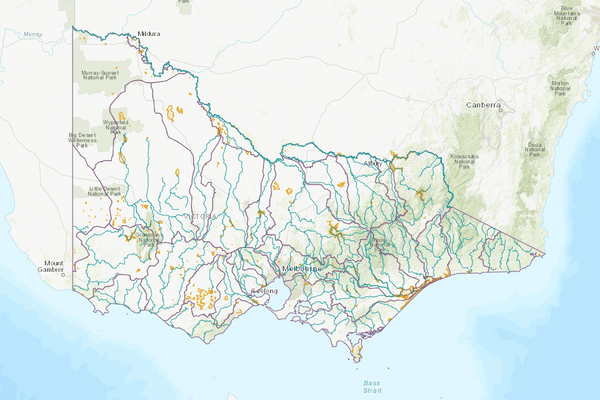
The Campaspe basin is in north-central Victoria. It extends 150 km north from the Great Dividing Range to the Murray River and is 45 km across at its widest point.
The basin experiences hot summers, particularly in the north. Annual rainfall varies from over 900 mm in the southern headwaters to under 400 mm at Echuca.
Most of the basin has been cleared for agriculture; however significant forested areas remain in the Axe Creek catchment and on the southern hills. The area is dominated by dryland farming which produces cereal crops, beef cattle, lambs and wool, while farming under irrigation is popular in the lower catchment for dairying and fruit and vine growing.
More information on water management and accounting is detailed in Water explained.
2024-25 overview
Available water
Catchment inflow was much lower than the previous year.
Licensed diversion restrictions
There was a similar level of restrictions on licensed diversions as the previous year.
Seasonal determinations
While high-reliability entitlements received 100% (the same as last year), less water was available for low-reliability water shares.
Water use
More water was diverted for consumptive purposes than the previous year.
When compared to the previous year, in 2024-25:
- less rainfall was received, catchment inflow was much lower, and storage levels peaked and declined at lower levels
- there was a similar level of restrictions on licensed diversions from streams
- high-reliability entitlements received 100% (the same as last year), however, less water was available for low-reliability water shares
- more water was diverted from the basin for consumptive uses.
Climate
Rainfall
In 2024-25, rainfall received in the Campaspe basin was lower than the previous year. Compared to the long-term average (1975-2025), rainfall was:
- the lowest on record in the centre of the basin
- very much below average in the basin’s south around Kyneton and Redesdale, and in the north around Rochester
- below average in the basin’s far north and far south to south-eastern boundary.
Figure 1 displays the rainfall received in 2024-25 compared to the long-term average.
Figure 1: Rainfall deciles, Campaspe basin
Sourced from the Australian Bureau of Meteorology
River basin water balance
This section describes the known and estimated inflows, outflows and change of storage volumes in the basin.
More detail on major on-stream storages, catchment inflows, diversions and small catchment dams can be found in the sections below the water balance.
In 2024-25, total inflows were lower than the volume flowing out at the end of the basin to the Murray River. This was a year of very low catchment inflows (11% of the long-term average – the lowest received in the last 20 years) and storage levels dropped substantially during the year, likely to meet downstream commitments.
Table 1: Water balance, Campaspe basin
Major on-stream storages
Major - greater than 1,000 ML - on-stream storages in the Campaspe basin are included in the water balance.
Storage levels
Storage levels in the Campaspe basin were 56% on 30 June 2025.
Lower than the previous year
On 30 June 2024, storage levels were 88% full.
Table 2: Storage levels, Campaspe basin
Inflows
Catchment inflow
Catchment inflow represents the volume of water flowing into the waterways of a basin. It is calculated as the total outflows and change in storage minus the known inflows.
Below average inflows of 27,871 ML were received (11% of the long-term average of 252,200 ML), much less than the previous year (75% of the long-term average).
Below average catchment inflow received
Catchment inflow was 11% of the long-term average annual volume of 252,200 ML.
Much less water received than the previous year
Catchment inflow was much less than the previous year (75% of the long-term average).
Wastewater treatment plants
Water treated at wastewater treatment plants can be used to supplement water available in the basin. Water discharged to waterways from treatment plants is included as an inflow to the water balance.
Information on treatment plants is reported in the water supply local reports for the water corporation responsible for managing the plant.
In this basin, wastewater treatment plants are managed by Coliban Water and Greater Western Water.
Outflows
Diversions
In 2024-25, 45,969 ML of water was diverted for consumptive uses: town, domestic and stock, irrigation and commercial supply, and 1,781 ML was transferred to White Swan Reservoir. This was more than the 39,023 ML diverted in the previous year. This includes a 3,622 ML decrease in the estimate of small catchment dam use volume.
Small catchment dams
Water harvested, used and lost by small catchment dams (farm dams) is included in the water balance.
Table 3: Small catchment dams, Campaspe basin
Entitlements and compliance
Entitlements provide the basis for how water is shared in the basin.
Entitlements to water in regulated systems in the Campaspe basin provide for the right to carry over unused allocation to the next season. In the Campaspe basin, these entitlement holders can carry over unused water up to 100% of their entitlement volume; any unused water above this amount is written off as an end-of-season forfeiture. There were no spill events in 2024-25 affecting customers’ spillable water accounts.
Consumptive diversions under bulk entitlements are assessed against the Murray-Darling basin annual cap target for the Campaspe valley. Details of this assessment are published annually in the MDBA’s cap register and annual water take report.
Since 2019-20, consumptive diversions are also assessed against the annual permitted takes under the Murray-Darling Basin Plan Sustainable Diversion Limit (SDL) compliance reporting which are annually published in the MDBA’s SDL accounts register of take and the Inspector-General of Water Compliance’s SDL compliance statement.
Entitlement volumes
Rights to water in the Campaspe basin are shown in Table 4.
Entitlement volumes represent an indication of a maximum volume of water that can be taken or allocated in any one year depending on the rules of the entitlement . The volume available in a particular year is dependent on the rules for allocating water set out in the entitlement, the seasonal conditions in that year and how much water was carried over from the previous year, which can vary. The rules for allocating water under an entitlement differ between entitlements and systems. This affects the ability and likelihood of water being taken in a particular year.
Table 4: Annual entitlement volumes at 30 June, Campaspe basin
Available water and take under entitlements
Total water available under entitlements represents the volume of water that was available to be taken by entitlement holders in 2024-25. The volume includes carryover from the previous year, seasonal allocations and net trade into the basin.
Water available under entitlements
While high-reliability entitlements received 100% (the same as last year), less water was available for low-reliability water shares.
Water taken under entitlements
There was 70,216 ML taken under entitlements in 2024-25, more than the previous year (63,814 ML).
Seasonal allocations
- High-reliability entitlement allocations opened at 100% (the same as the previous year). Low-reliability entitlements opened at 0% and reached 48% in January 2025, lower than the 100% in the previous year.
- For the 14th year in a row, the 2024-25 Coliban Water rural season opened with an allocation of 100%.
Restrictions on licensed diversions from streams
- There was a maximum of 18 streams with bans on licensed diversions from January to June 2025.
- During the previous year, bans on diversions peaked in March 2024 for the same 18 streams.
- There were no restrictions in place for the Meadow Valley Creek, Mia Mia Creek, and Native Gully Creek for the entirety of 2024-25.
Available water and take table
This table shows the volume of available water and the volume taken under entitlements in 2024-25.
More information on available water and take has been detailed in How we account for surface .
In 2024-25, more water was taken under entitlements than the previous year.
Table 5: Available water and take under entitlements, Campaspe basin
Compliance
Compliance against water entitlements is reported for this basin in 3 areas:
- entitlement issued: that the volume of entitlements issued in a basin does not exceed formal caps, and has not increased without appropriate approvals
- water taken: that the volume of water taken during the year does not exceed the volume considered to be available for consumptive and/or in-stream use during that year
- bulk entitlement provisions: that holders of entitlements do not breach any provisions that are documented in their bulk entitlement orders.
Key points on compliance against entitlements in 2024-25
Total entitlement volume
There was no net increase in the total entitlement volume from the previous year.
Total volume diverted
The total volume diverted under entitlements (63,629 ML) was within the volume available for the year (125,153 ML).
Individual bulk entitlements
No individual bulk entitlement holder took more than the annual volume made available to them.
Exceptions to compliance
Individual bulk entitlement holders complied with all provisions in their entitlements. However, one compliance difficulty was reported. See note below.
Note to compliance difficulties:
- Goulburn-Murray Water (GMW) reported that flows downstream of Lake Eppalock were below the minimum requirements on 2 days. Releases were reduced below the required minimum flow at the start of December 2024, following localised rain. Minimum passing flows not provided, a total of 32 ML, were credited to the passing flow account for later use.
Water for the environment
Environmental watering sites
Environmental watering sites and environmental values in the Campaspe basin that depend on water for the environment include:
- several native fish species, including Murray cod, silver perch, golden perch, Murray-Darling rainbowfish and flat-headed gudgeon
- Platypus, rakali (water rats), turtles and frogs are also present along the length of the river
- riparian vegetation is dominated by large, mature river red gum trees that support wildlife (such as the swift parrot and squirrel glider).
Water from the Campaspe basin also feeds into the Murray basin, helping to maintain internationally significant environmental assets (such as Gunbower Forest and Kerang Wetlands) in that basin.
Environmental water reserve
In 2024-25, water for the environment in the Campaspe basin comprised:
- the Campaspe River Environmental Entitlement 2013, which includes 20,855 ML of high-reliability and 4,394 ML of low-reliability entitlements held by the Victorian Environmental Water Holder (VEWH)
- the Environmental Entitlement (Campaspe River - The Living Murray Initiative) 2007, which includes 126 ML of high-reliability and 5,048 ML of low-reliability entitlements held by the VEWH
- 6,594 ML of high-reliability water shares and 395 ML of low-reliability water shares held for the environment by the Commonwealth Environmental Water Holder
- 30 ML take and use licence held by the Commonwealth Environmental Water Holder
- water set aside for the environment through the operation of passing flow conditions:
- on consumptive bulk entitlements held by Coliban Water, Greater Western Water and Goulburn-Murray Water
- on licensed diversions
- all other water in the basin not allocated for consumptive uses: this water also provides social, recreational and cultural benefits.
Environmental water use
In 2024-25, 21,397 ML of environmental water was delivered in-stream in the Campaspe basin. Additionally, there was 580 ML of passing flows withheld and then delivered under the Bulk Entitlement (Campaspe System - Coliban Water) Conversion Order 1999 in the Coliban River. There was also an additional 210 ML delivered in-stream in the Campaspe River (110 ML to Gaynor Swamp and 99 ML to the Campaspe River) that was diverted from the Goulburn basin.
Management responsibilities
Management of water in the Campaspe basin is undertaken by various parties
| Authority | Management responsibilities |
|---|---|
| Coliban Water |
|
| Goulburn-Murray Water |
|
| Greater Western Water |
|
| North Central Catchment Management Authority |
|
| Water supply system | 2023-24 (ML) | 2024-25 (ML) |
|---|---|---|
| Goornong | 106 | 82 |
| Main integrated system | 182 | 248 |
| Bendigo system | 11,769 | 15,200 |
| Castlemaine system | 2,060 | 2,213 |
| Heathcote system | 304 | 404 |
| Kyneton system | 1,211 | 1,279 |
| Trentham | 100 | 147 |