About the area
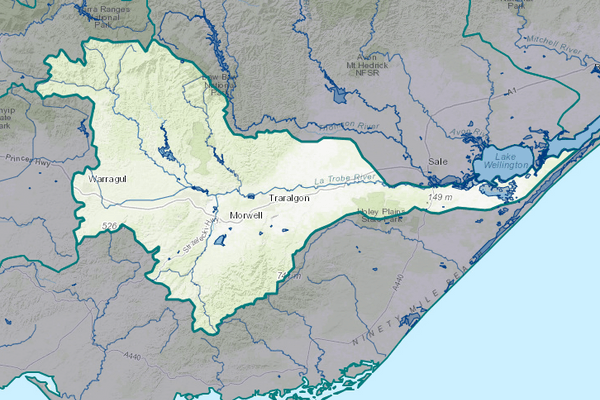
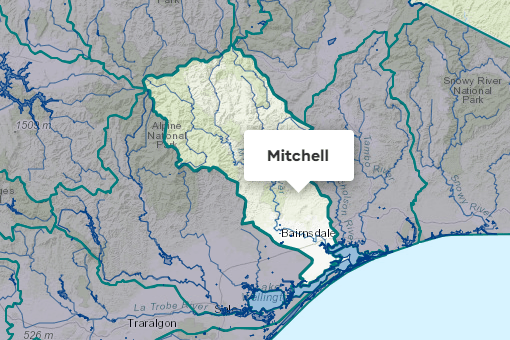
The Thomson basin is in south-east Victoria. Major rivers include the Thomson and Macalister rivers, which join the Latrobe River before flowing into the Gippsland Lakes, and the Avon River, which flows directly into Lake Wellington.
The large northern section of the basin, containing the headwaters of the Thomson and Macalister Rivers, is forested and mountainous.
Annual rainfall is over 1,200 mm in the upper reaches of the basin, and reduces to between 400-600 mm in the south, which is amongst the driest area in Gippsland on average.
Water from the Thomson basin is used to supply agriculture, including a large irrigation area in the Thomson and Macalister River valleys, as well as urban supply for the Melbourne system.
More information on water management and accounting is detailed in Water explained.
2024-25 overview
Available water
Catchment inflow was lower than the previous year.
Licensed diversion restrictions
There were similar restrictions on licensed diversions to the previous year.
Seasonal determinations
Thomson-Macalister system reached 100% allocation to high- and low-reliability water shares, the same as the previous year.
Water use
A similar amount of water was diverted for consumptive purposes to the previous year.
When compared to the previous year, in 2024-25:
- less rainfall was received, catchment inflows were lower, and storage levels peaked and declined at lower levels
- there were similar restrictions on licensed diversions from streams
- seasonal allocations were the same, with both high- and low-reliability entitlements reaching 100% allocation; a whole-system spill entitlement was not available unlike the previous year
- a similar amount of water was diverted from the basin for consumptive uses.
Climate
Rainfall
In 2024-25, rainfall received in the Thomson basin was close to average across most of the basin, lower than the previous year.
Figure 1 displays the rainfall received in 2024-25 compared to the long-term average (1975-2025).
Figure 1: Rainfall deciles, Thomson basin
Sourced from the Australian Bureau of Meteorology
River basin water balance
This section describes the known and estimated inflows, outflows and change of storage volumes in the basin.
More detail on major on-stream storages, catchment inflows, diversions and small catchment dams can be found in the sections below the water balance.
Of the total inflows, 51% flowed out into the Latrobe River and Lake Wellington in 2024-25.
Water balance table
The table below shows the total volumes of water available and supplied from water resources in the Thomson basin in 2024-25.
Table 1: Water balance, Thomson basin
Major on-stream storages
Major - greater than 1,000 ML - on-stream storages in the Thomson basin are included in the water balance.
Storage levels
Storage levels were 73% in June 2025.
Lower than the previous year
Storages levels were 86% in June 2024.
Table 2: Storage levels, Thomson basin
Inflows
Catchment inflow
Catchment inflow represents the volume of water flowing into the waterways of a basin. It is calculated as the total outflows and change in storage minus the known inflows.
Below average inflows of 594,847 ML were received (62% of the long-term average of 955,400 ML), less than the previous year (132% of the long-term average).
Below average inflow
Catchment inflow was 62% of the long-term average of 955,400 ML.
Less water received than the previous year
Catchment inflow was lower than the previous year (132% of the long-term average).
Wastewater treatment plants
Water treated at wastewater treatment plants can be used to supplement water available in the basin. Water discharged to waterways from treatment plants is included as an inflow to the water balance.
Information on treatment plants is reported in the water supply local reports for the water corporation responsible for managing the plant.
In this basin, wastewater treatment plants are managed by Gippsland Water.
Outflows
Diversions
In 2024-25, 394,278 ML of water was diverted for consumptive uses: town, domestic and stock, irrigation and commercial supply. This was similar to the 367,195 ML diverted in the previous year.
Small catchment dams
Water harvested, used and lost by small catchment dams (farm dams) is included in the water balance.
Table 3: Small catchment dams, Thomson basin
Entitlements and compliance
Entitlements provide the basis for how water is shared in the basin.
Melbourne Water holds a bulk entitlement to surface water from the Thomson River. This entitlement is one of four that contribute to the Greater Yarra system - Thomson River Pool, which primarily supplies Melbourne and supports regional urban water corporations, including Barwon Water, Gippsland Water, South Gippsland Water and Westernport Water. Surface water is also diverted by licensed diverters and is harvested in small catchment dams.
The Victorian Environmental Water Holder (VEWH) holds bulk and environmental entitlements for the Thomson and Macalister rivers, respectively. Water available under these entitlements is used to support streamflows, or can be diverted out of waterways to wetlands in the basin.
Entitlement volumes
Rights to water in the Thomson basin are shown in Table 4.
Entitlement volumes represent an indication of a maximum volume of water that can be taken or allocated in any one year depending on the rules of the entitlement. The volume available in a particular year is dependent on the rules for allocating water set out in the entitlement, the seasonal conditions in that year and how much water was carried over from the previous year, which can vary. The rules for allocating water under an entitlement differ between entitlements and systems. This affects the ability and likelihood of water being taken in a particular year.
Table 4: Annual entitlement volumes at 30 June, Thomson basin
Available water and take under entitlements
Total water available under entitlements represents the volume of water that was available to be taken by entitlement holders in 2024-25. The volume includes carryover from the previous year, seasonal allocations and net trade into the basin.
Water taken
There was 430,997 ML taken under entitlements in 2024-25, similar to the previous year (396,641 ML).
Seasonal allocations and restrictions on licensed diversions from streams
- In the declared Thomson-Macalister system, high-reliability entitlement allocations opened the water year at 55%, and reached 100% in September (2 months later than the previous year). Low-reliability entitlement allocations reached 100% in April 2024 (the same as the previous year).
- There were restrictions on licensed diversions from the Avon River at Stratford and the Channels, and Valencia Creek in 2024-25, these were the same stream sections restricted during the previous year.
Available water and take table
This table shows the volume of available water and the volume taken under entitlements in 2024-25.
More information on available water and take has been detailed in How we account for surface
In 2024-25, more water was taken under entitlements than the previous year.
Table 5: Available water and take under entitlements, Thomson basin
Compliance
Compliance against water entitlements is reported for this basin in 3 areas:
- entitlement issued: that the volume of entitlements issued in a basin does not exceed formal caps, and has not increased without appropriate approvals
- water taken: that the volume of water taken during the year does not exceed the volume considered to be available for consumptive and/or in-stream use during that year
- bulk entitlement provisions: that holders of entitlements do not breach any provisions that are documented in their bulk entitlement orders.
Key points on compliance against entitlements in 2024-25
Total entitlement volume
There was an allowed net increase of 2,260 ML in the total entitlement volume from the previous year. See note below.
Total volume diverted
The total volume diverted under entitlements (430,997 ML) was within the volume available for the year (507,745 ML).
Individual bulk entitlements
No individual bulk entitlement holder took more than the annual volume made available to them.
Exceptions to compliance
Individual bulk entitlement holders complied with all provisions in their entitlements.
Note to entitlement volume increase:
- In 2024-25, a new mitigation water environmental entitlement for the Thomson/Macalister system was issued to provide 1,569 ML and 692 ML of high- and low-reliability entitlements, respectively. This entitlement was issued to mitigate the specific impacts identified from the MID2030 Project for high priority environmental sites.
Water for the environment
Environmental watering sites
Environmental watering sites and environmental values in the Thomson basin that depend on water for the environment include:
- the Thomson River from the Aberfeldy River confluence to Cowwarr Weir; a heritage river reach, with high-value native streamside vegetation and high-quality in-stream habitat
- the Thomson River’s Australian grayling population
- the Heyfield wetlands, one of the few remaining freshwater wetland sites in the Gippsland Plains landscape
- the Macalister River, supporting 7 migratory native fish species, platypus and the native water rat (Rakali)
- the Gippsland Lakes, which are listed as internationally significant wetlands under the Ramsar Convention and partially rely on freshwater inputs from the Thomson basin to function ecologically.
Environmental water reserve
In 2024-25, water for the environment in the Thomson basin comprised:
- the Bulk Entitlement (Thomson River - Environment) Order 2005, which includes 3.9% share of inflows and 10,000 ML of high-reliability entitlement held by the VEWH and water set aside for the environment through the operation of passing flow conditions on the entitlement
- the Macalister River Environmental Entitlement 2010, which includes 12,460 ML of high-reliability and 6,230 ML of low-reliability entitlements held by the VEWH
- the Thomson/Macalister System – Mitigation Water Environmental Entitlement 2024, which includes 1,569 ML of high-reliability and 692 ML of low-reliability entitlement held by the VEWH
- water set aside for the environment through the operation of passing flow conditions:
- on consumptive bulk entitlements held by Southern Rural Water
- on licensed diversions
- all other water in the basin not allocated under entitlements: this water also provides social, recreational and cultural benefits.
Environmental water use
In 2024-25, a total of 41,228 ML of environmental water was delivered in-stream in the Thomson basin.
Management responsibilities
Management of water in the Thomson basin is undertaken by various parties
| Authority | Management responsibilities |
|---|---|
| Gippsland Water |
|
| Melbourne Water |
|
| Southern Rural Water |
|
| West Gippsland Catchment Management Authority |
|
| Water supply system | 2023-24 (ML) | 2024-25 (ML) |
|---|---|---|
| Heyfield | 254 | 303 |
| Maffra System | 767 | 779 |
| Water supply system | 2023-24 (ML) | 2024-25 (ML) |
|---|---|---|
| Macalister Irrigation District | 149,870 | 165,428 |